INTERACT4 Post-Hoc Analysis: Prehospital Blood Pressure Parameters and Outcomes in Acute Intracerebral Hemorrhage
Presented by Dr. Chen Chen (China), this post-hoc analysis of the landmark INTERACT4 trial evaluated prehospital blood pressure (BP) parameters and patient outcomes in acute intracerebral hemorrhage (ICH). The primary trial examined ambulance-initiated BP lowering in patients with suspected acute stroke within two hours of onset and a baseline systolic blood pressure (SBP) >150 mmHg.
Key Findings & Results
- Cohort Characteristics (n=1,029):
- Mean age: 64.9 ± 12.3 years
- Sex: 67.7% male (697/1,029)
- Median onset-to-randomization: 58 minutes
- Baseline severity: Median NIHSS 14
- Hematoma location: Deep hematomas present in 84.7% of cases (872/1,029)
- Prehospital Blood Pressure Control:
- Median speed of SBP reduction achieved in transport was 18 mmHg per 10 minutes.
- Median pre-hospital SBP reduction was 17.0 mmHg.
- Efficacy & Clinical Outcomes:
- Lower prehospital minimal SBP, greater SBP reduction, and faster SBP reduction were independently and significantly associated with improved functional outcomes at 90 days (mRS shift analysis) and reduced overall mortality.
- cOR of 0.75 (95% CI: 0.60–0.92) indicated a 25% reduction in the odds of worse functional outcome/disability across the mRS spectrum for the intervention group.
- Handover Dynamics & Risk:
- A larger SBP difference between ambulance handover and hospital emergency department arrival (representing handover instability) was significantly associated with higher 90-day mortality (p=0.04).
- Associated risks included higher risk of death or neurological deterioration within 7 days (p=0.02).
- Future Directions:
- Investigators highlighted the emerging potential of prehospital point-of-care ICH biomarkers (e.g., GFAP rapid testing) combined with lightweight mobile prehospital imaging to facilitate ultra-early diagnosis and targeted therapy prior to hospital arrival.
Conclusion: In patients presenting with hyperacute ICH, faster and larger prehospital SBP reductions achieved inside the ambulance correlate with improved 90-day functional recovery. Crucially, ensuring smooth hemodynamic stability during patient handover to the emergency department is paramount to prevent hematoma expansion and excess mortality.
OPTEC: Individual Participant Data Meta-Analysis on Optimizing Blood Pressure in Endovascularly Treated Ischemic Stroke
Dr. Xia Wang (Australia) presented findings from the OPTEC collaboration, a comprehensive Individual Participant Data (IPD) meta-analysis assessing blood pressure management following successful endovascular thrombectomy (EVT) for large vessel occlusion (LVO) ischemic stroke.
Key Findings & Results
- Pooled Study Population:
- Pooled IPD from 7 randomized controlled trials encompassing 2,412 participants across diverse global centers (62% Asian populations).
- Demographic profile: Mean age 71 years; 54% male; median NIHSS 15; 70% achieved complete reperfusion (eTICI 2b/2c/3).
- Hemodynamic Separation:
- Achieved mean SBP separation between intensive and guideline-based control arms was 7.3 mmHg over the first hour and 11.1 mmHg over 24 hours.
- Primary Endpoint (90-Day mRS Shift):
- Intensive BP lowering significantly worsened 90-day functional outcome distributions across the full mRS spectrum compared with standard guideline-based targets (adjusted cOR 1.16, 95% CI: 1.01–1.34, p=0.041).
- Safety & Subgroup Interactions:
- Intensive BP lowering provided no reduction in the rate of symptomatic intracerebral hemorrhage (sICH: 9.6% intensive vs 8.7% guideline, p=0.50).
- Significant baseline interactions were observed: higher baseline SBP (p=0.026) and poor collateral status (p=0.008) correlated with a significantly greater magnitude of harm from intensive lowering.
- Comparison with HOPE Trial:
- The harmful effect of intensive BP control remained consistent regardless of the rate or magnitude of BP reduction.
- Discrepancies with the positive HOPE trial were attributed to lower overall baseline SBP in HOPE (136 mmHg vs. 155 mmHg in OPTEC) and differences in protocol design.
Conclusion: Fixed intensive blood pressure lowering following successful endovascular thrombectomy worsens 90-day functional recovery and should be avoided in routine clinical practice. Post-EVT blood pressure management should adhere strictly to current guideline targets while incorporating individualized clinical assessments.
INTERACT1 and INTERACT2 Pooled Analysis: Divergent Effects of ACE Inhibitors and ARBs in Intracerebral Hemorrhage
Dr. Alastair Paterson (UK) presented a pooled analysis of 2,896 patients from the INTERACT1 and INTERACT2 clinical trials, evaluating whether specific classes of antihypertensive medications exert differential neuroprotective effects during acute intracerebral hemorrhage (ICH).
Key Findings & Results
- Study Design & Cohorts:
- Primary ICH patients (n=2,896) from INTERACT1 (n=404) and INTERACT2 (n=2,829) were categorized based on oral antihypertensive class exposure within the first 7 days:
- ACE inhibitors (ACEi; n=1,332)
- Angiotensin Receptor Blockers (ARBs; n=304)
- Primary ICH patients (n=2,896) from INTERACT1 (n=404) and INTERACT2 (n=2,829) were categorized based on oral antihypertensive class exposure within the first 7 days:
- Other antihypertensives (n=676)
- No oral antihypertensive therapy (n=584)
- Exclusion criteria: Death within 7 days or combination therapy (ACEi + ARB).
- Primary Endpoint:
- Exposure to ACE inhibitors within the first 7 days was significantly associated with lower odds of death or major dependency at 90 days (mRS 3–6) across the entire cohort (adjusted OR 0.69, 95% CI: 0.51–0.94, p=0.018).
- Divergence from ARBs:
- The functional benefit seen with ACE inhibitors was not observed with ARB exposure (adjusted OR 0.92, p=0.687).
- Among patients managed within guideline BP targets, ARB exposure trended toward a higher odds ratio of death or dependency (1.86, p=0.045).
- Blood Pressure Independence:
- Both ACEi and ARB cohorts demonstrated nearly identical SBP reduction curves over the first 24 hours, indicating that the protective mechanism of ACE inhibitors operates independently of blood pressure lowering alone.
- Biological Mechanisms:
- Preclinical screening in zebrafish models demonstrated that ACE inhibitors reduced neural cell death by ~55% by downregulating mitochondrial ROS generation, matrix metalloproteinases (MMPs), and microglial neuroinflammation.
Conclusion: The specific choice of antihypertensive agent plays a critical role in acute ICH care. ACE inhibitor administration during the acute post-ICH phase is associated with improved 90-day functional outcomes independent of blood pressure reduction, providing a strong rationale for dedicated prospective randomized controlled trials.
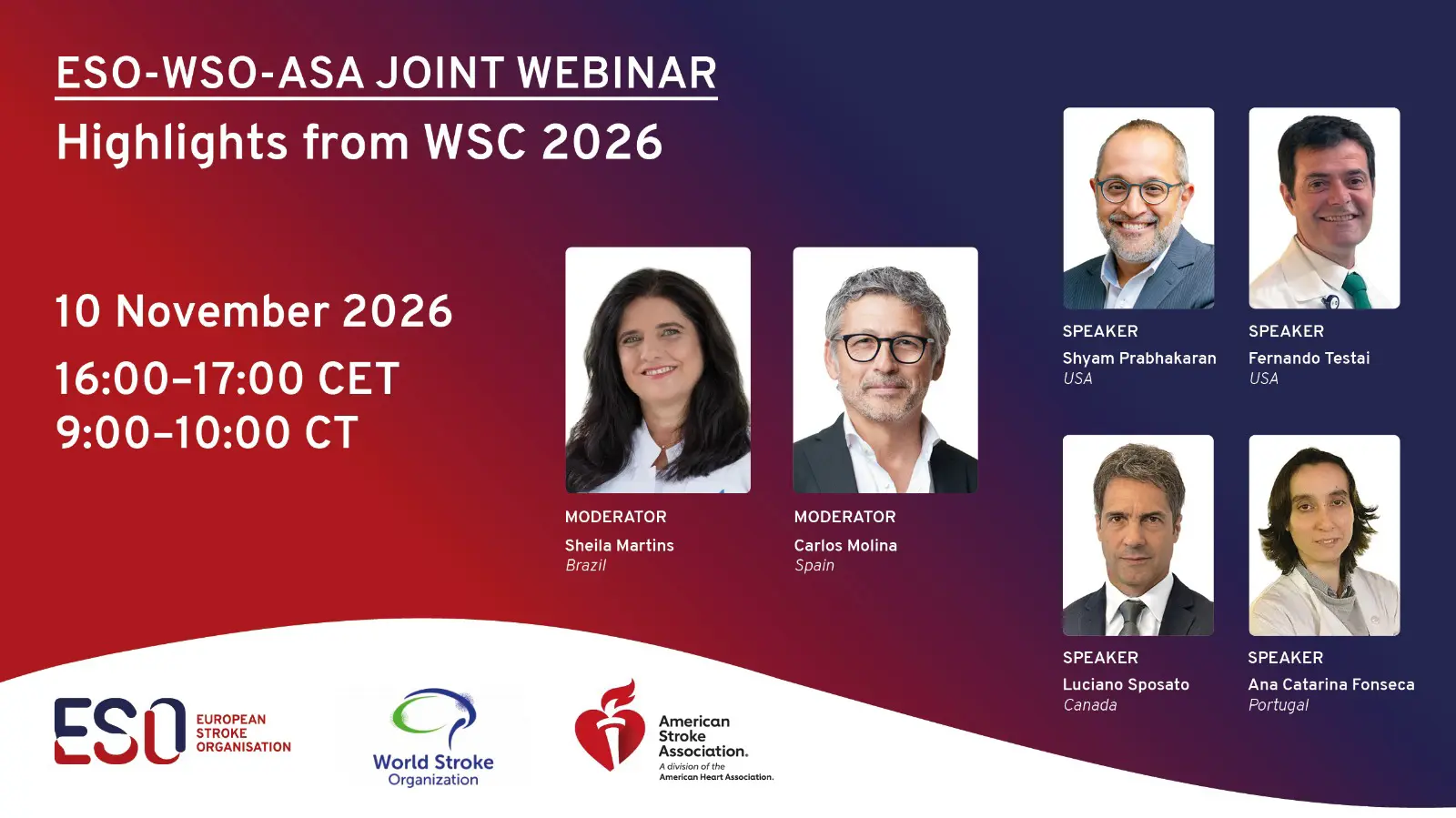
WSC 2026 Highlights - Joint webinar ESO-WSO-AHA/ASA
Join us for a live roundtable and Q&A session on Tuesday 10 November 2026 from 16:00-17:00 CET/9:00-10:00 CT to discuss the most important advances in research and clinical care of patients with stroke.
Highlights from the World Stroke Congress (WSC 2026) will be presented by experts from leading stroke societies: the European Stroke Organisation (ESO), the World Stroke Organization (WSO) and the American Heart Association/American Stroke Association (AHA/ASA). This collaborative session will highlight important research, evolving treatment strategies, and novel techniques in stroke care.