Intra-Arterial Tenecteplase According to Procedural Reperfusion Pattern After Successful Endovascular Thrombectomy: A Post Hoc Analysis of the ANGEL-TNK Trial
Presenter: Ngaki Lau, Beijing Tiantan Hospital of Capital Medical University
Background
Despite successful endovascular thrombectomy (EVT), many patients with acute
ischemic stroke do not achieve optimal clinical recovery. This angiographic-clinical
mismatch may result from residual distal thrombotic occlusions that are not fully
captured by standard reperfusion grading, creating a potential role for adjunctive intraarterial thrombolysis (IAT).
The original ANGEL-TNK trial demonstrated that intra-arterial tenecteplase (IA-TNK)
administered after successful EVT improved the proportion of patients achieving
excellent functional outcomes (modified Rankin Scale [mRS] 0-1 at 90 days) compared
with standard medical treatment.
Objective
This post hoc analysis investigated whether the efficacy and safety of IA-TNK differed
according to procedural reperfusion patterns, defined by:
- Final eTICI reperfusion grade
- Number of thrombectomy passes performed before randomisation
The investigators hypothesised that patients with both incomplete reperfusion and
greater procedural burden may derive the greatest benefit from IA-TNK.
Methods
From the 255 patients included in the ANGEL-TNK full analysis set, 253 were eligible for
this analysis. Patients were categorised into:
Multipass incomplete reperfusion pattern
- ≥2 thrombectomy passes
- eTICI 2b50 or 2b67
- n = 87
Other reperfusion patterns
- Single-pass procedures and/or eTICI 2c/3 reperfusion
- n = 166
- The primary outcome was achievement of mRS 0-1 at 90 days. Secondary efficacy
and safety outcomes were also evaluated.
Key Results
Primary Outcome
A significant treatment interaction was observed according to procedural reperfusion
pattern.
Among patients with the multipass incomplete reperfusion pattern:
- mRS 0-1 at 90 days achieved in 46.5% receiving IA-TNK versus 15.9% receiving
standard medical treatment - Relative Risk (RR) 2.85 (95% CI 1.52-5.37)
- Interaction p = 0.01
Among patients with other reperfusion patterns:
- mRS 0-1 at 90 days achieved in 37.4% receiving IA-TNK versus 32.5% receiving
standard treatment - RR 1.07 (95% CI 0.64-1.79)
These findings suggest that the greatest treatment effect was seen in patients with
residual incomplete reperfusion after multiple thrombectomy passes.
Secondary Outcomes
No significant treatment-effect heterogeneity was observed across:
- Overall mRS distribution
- mRS 0-2 and mRS 0-3 outcomes
- NIHSS improvement at 36 hours
- Quality-of-life measures
- Perfusion imaging outcomes
- Infarct growth measures
Safety Outcomes
No significant differences were identified in:
- Symptomatic intracranial haemorrhage
- Any intracranial haemorrhage
- 90-day mortality
across treatment groups and reperfusion patterns.
Interpretation
The analysis suggests that combining the number of thrombectomy passes with final
eTICI reperfusion grade may better identify patients most likely to benefit from adjunctive
IA-TNK than using eTICI grade alone. Multiple thrombectomy passes may indicate greater
residual thrombotic burden and a higher likelihood of distal embolisation, providing a
potential therapeutic target for intra-arterial thrombolysis.
Limitations
The presenter acknowledged several important limitations:
- Post hoc exploratory analysis
- Small sample size, particularly within subgroups
- Limited number of safety events
- Heterogeneous “other pattern” comparison group
- Findings require prospective validation before routine clinical adoption
Take-Home Message
This exploratory post hoc analysis of the ANGEL-TNK trial suggests that the benefit of
adjunctive intra-arterial tenecteplase after successful EVT may depend on procedural
reperfusion patterns. Patients with eTICI 2b50/2b67 reperfusion following two or more
thrombectomy passes demonstrated the strongest signal of benefit, achieving
substantially higher rates of excellent functional outcome at 90 days. These findings
support further prospective studies to validate procedural reperfusion pattern as a
potential marker for selecting patients for adjunctive intra-arterial thrombolysis.
Edoxaban for stroke prevention in intracranial hemorrhage survivors with atrial fibrillation (ENRICH AF): An open label, blinded, endpoint, parallel group, randomized trial
Presenter: Shoamanesh A, et al
Background:
Antithrombotic use in patients with AF and ICH remains debated. ENRICH AF evaluated the use of edoxaban for ICH survivors with AF. Recent trials revealed that edoxaban was probably safer amongst all NOACs with regards to intracranial bleeding as a side effect.
Inclusion Criteria:
Patients aged > 45 years
ICH/ SDH/ cSAH >= 2 weeks ago
AF or atrial flutter
CHADS2VASc >=2
However, patients with cSAH were excluded after the DSMB meeting in 2023.
Results:
944 patients were randomized into edoxaban (n= 467) vs no anticoagulation (n= 477)
Event driven – stroke (ischemic OR hemorrhagic) OR systemic embolism
55% patients had persistent AF
52% got antiplatelet(s) in control arm
HR for primary outcome: 0.88 (0.61 – 1.26) – 11.8 vs 12.8%
HR for Ischemic stroke alone: 0.57 (0.36 – 0.90) – 6.2 vs 10.3%
HR for systemic embolism: 0.25 (0.03 – 2.21) – 0.2 vs 0.8%
HR for ICH: 2.99 (1.41 – 6.37) – 5.8 vs 1.9%
Discussion:
Largest randomized trial evaluating stroke prevention with oral anticoagulation following ICH in patients with AF. The benefit of prevention of ischemic stroke was offset by higher rates of ICH. Bleeding rates were lesser in patients getting 30mg of edoxaban v/s 60mg. The results of this trial support individualized antithrombotic decision making after ICH and highlight the need for safer stroke prevention strategies in this high risk population.
Effects of blood pressure lowering by hematoma location in acute ICH: pooled individual participation data of the INTERACT and ATACH-2 trials
Presenter: Ren X, et al
Background:
The treatment of intensive blood pressure lowering improves functional outcome in patients with acute intracerebral hemorrhage. However, different hematoma locations reflect different etiologies. It is not known whether this treatment effect is homogenous across different hematoma locations.
This study evaluated whether the treatment effects of early intensive BP lowering on functional outcome in ICH patients was modified by hematoma location.
Methodology:
The study did an individual patient data level analysis for all the INTERACT and ATACH-2 trials. All of these trials were international, multicentre, blinded outcome assessed, randomized trials which had investigated the effect of BP lowering on functional outcomes in ICH.
ICH location was classified as deep, cortical and infratentorial and the primary outcome was mRS scores between 3-6 for patients treated with a target systolic BP < 140 v/s target systolic BP <180 mm Hg
Results:
11288 patients were analysed (n=9202 for deep ICH; n=1141 for lobar ICH; n=945 for intratentorial ICH)
The HR for mRS 3-6 was found to be 0.81 (0.74-0.89) for deep ICH; 0.81 (0.59-1.0) for infratentorial ICH; and 1.20 (0.91-1.60) for lobar ICH
Discussion:
There is a difference in pathophysiology for ICH involving different anatomical regions with cerebral amyloid angiopathy predominant for lobar ICH and hypertension related disease for deep and infratentorial ICH.
This study demonstrated that patients with acute deep ICH had statistically significantly better outcomes when treated with a target systolic BP <140mm Hg.
HOPE Trial Post Hoc: Sustained SBP ≥160 mmHg Linked to Hemorrhagic Transformation After Complete Reperfusion
SEOUL, 22 October 2026 — After a complete reperfusion with thrombectomy, keeping systolic blood pressure under 140 mmHg was linked to roughly a third fewer brain bleeds. The risk climbed steeply once mean pressure stayed at or above 160 mmHg for the first 12 hours. These new findings come from a post hoc analysis of the Spanish HOPE trial, presented in the plenary session of the 18th World Stroke Congress.
The study was presented by Joan Miquel Fernández-Vidal of Hospital de la Santa Creu i Sant Pau, Barcelona. It suggests the key is not driving pressure as low as possible. Instead, it is avoiding sustained high pressure in the hours after the vessel has been fully reopened. The data are unpublished.
A question guidelines left open
Hemorrhagic transformation (HT) is bleeding into the infarcted tissue after the clot is removed. It is one of the main faces of reperfusion injury, and it worsens recovery. Even asymptomatic HT has been tied to worse disability at three months.
Blood pressure seemed the obvious lever. Yet several randomized trials found that pushing systolic pressure (SBP) aggressively low after thrombectomy was neutral or harmful. As a result, both the AHA/ASA and the European Stroke Organisation now advise against targeting SBP below 140 mmHg after successful reperfusion.
The HOPE trial (Camps-Renom et al., JAMA Neurology 2026) took a different approach. It tailored targets to how well the vessel had been reopened. Patients with complete or near-complete reperfusion were kept at 100–140 mmHg, and those with partial reperfusion at 140–160 mmHg. Functional independence at 90 days rose from 47.1% to 60.0%. HT at 24 hours fell from 31.6% to 22.3%, with no increase in symptomatic bleeding.
The new analysis asked what drives that reduction in bleeding: which blood-pressure measures matter, at what level, and when.
How the study was done
HOPE was a multicenter, open-label phase 3 trial with blinded endpoint assessment, run at 11 stroke centers in Spain. It enrolled 440 patients with anterior-circulation large-vessel occlusion treated within 24 hours. Randomization happened within an hour of the final angiogram, and patients did not need to be hypertensive to enter. The control arm was managed to the standard ceiling of 180 mmHg.
The investigators focused on patients with complete or near-complete reperfusion (mTICI 2c–3). Partial reperfusion was excluded because that subgroup showed no apparent benefit in the main trial. After excluding patients without follow-up imaging, 378 patients were analyzed.
A blinded core lab of two neuroradiologists and two neurologists read the 24-hour CT scans using the Heidelberg classification. Blood pressure was recorded every 30 minutes in the intensive arm and every 60 minutes in the standard arm. The team examined mean SBP, time in target range, peaks above 180 mmHg and pressure variability. Each was measured across windows from the first hour to the first 24 hours.
What they found
One in three patients bled despite a fully reopened artery. HT occurred in 139 of 378 patients: 42.6% in the standard arm and 30.9% in the intensive arm. Patients who bled had more severe strokes, larger early infarcts, more thrombectomy passes and later reperfusion.
Intensive control was linked to less bleeding, even after accounting for those factors (adjusted OR 0.62, 95% CI 0.39–0.99; p=0.046). The bleeds mattered for recovery. Only 39.1% of patients with HT were functionally independent at three months, against 64.7% of those without (p<0.001). The type of bleed and the rate of symptomatic hemorrhage did not differ between arms.
Surprisingly, the usual blood-pressure summaries barely separated the groups. Average pressure, time in target and variability over 24 hours were almost identical in patients with and without HT. The only exception was greater beat-to-beat variability in the very first hour.
The signal appeared once the analysts looked at shape and duration. Over the first hour or three, pressure showed no link with bleeding. From six hours onward, the association became significant and clearly nonlinear. Risk stayed flat across the usual range and then rose sharply at higher levels.
Only one threshold held up after adjustment: a mean SBP of 160 mmHg or more. Over the first 12 hours, it carried more than four times the odds of HT (adjusted OR 4.27, 95% CI 1.48–13.54). Over 24 hours, the odds were three times higher (adjusted OR 3.22, 95% CI 1.06–10.49). Such exposure was rare under intensive care (1.2%) but more common under standard care (8.9% over 12 hours).
Pressure trajectories also diverged over time. Patients who bled ran consistently higher curves (time × HT p=0.011). This divergence was concentrated in the intensive arm during the first 12 hours.
What it means
The authors’ message was “not the lower, the better” but “avoid sustained high SBP” in fully reperfused patients. What counts is hours spent above roughly 160 mmHg, not a single reading. They also stressed that asymptomatic HT should not be dismissed, given how strongly it tracked with worse recovery.
The talk closed with an open question for the field. Is the guideline ceiling of 180 mmHg too permissive once the artery has been completely reopened?
The authors flagged clear limits. This was a post hoc, exploratory analysis that tested many parameters, time windows and thresholds. Few patients were exposed to very high pressures. Mean SBP may miss the size and length of individual spikes. Finally, the timing of cause and effect is uncertain: up to 20% of HT appears early after thrombectomy, and pressure during the procedure was not measured.
Key numbers
| Measure | Standard care | Intensive care |
|---|---|---|
|
Any hemorrhagic transformation |
42.6% |
30.9% |
|
Exposure to mean SBP ≥160 mmHg, 0–12 h |
8.9% |
1.2% |
|
Exposure to mean SBP ≥160 mmHg, 0–24 h |
7.7% |
1.2% |
| Association | Estimate |
|---|---|
|
Intensive care vs standard, any HT (adjusted) |
OR 0.62 (95% CI 0.39–0.99) |
|
Mean SBP ≥160 mmHg over 0–12 h, any HT |
OR 4.27 (95% CI 1.48–13.54) |
|
Mean SBP ≥160 mmHg over 0–24 h, any HT |
OR 3.22 (95% CI 1.06–10.49) |
|
mRS 0–2 at 3 months, HT vs no HT |
39.1% vs 64.7% (p<0.001) |
Source: plenary presentation, 18th World Stroke Congress, Seoul, 21–23 October 2026. Unpublished data. Parent trial: Camps-Renom et al., JAMA Neurol. 2026;83(8):788–797.
Highlights From Day 2 of the World Stroke Congress 2026
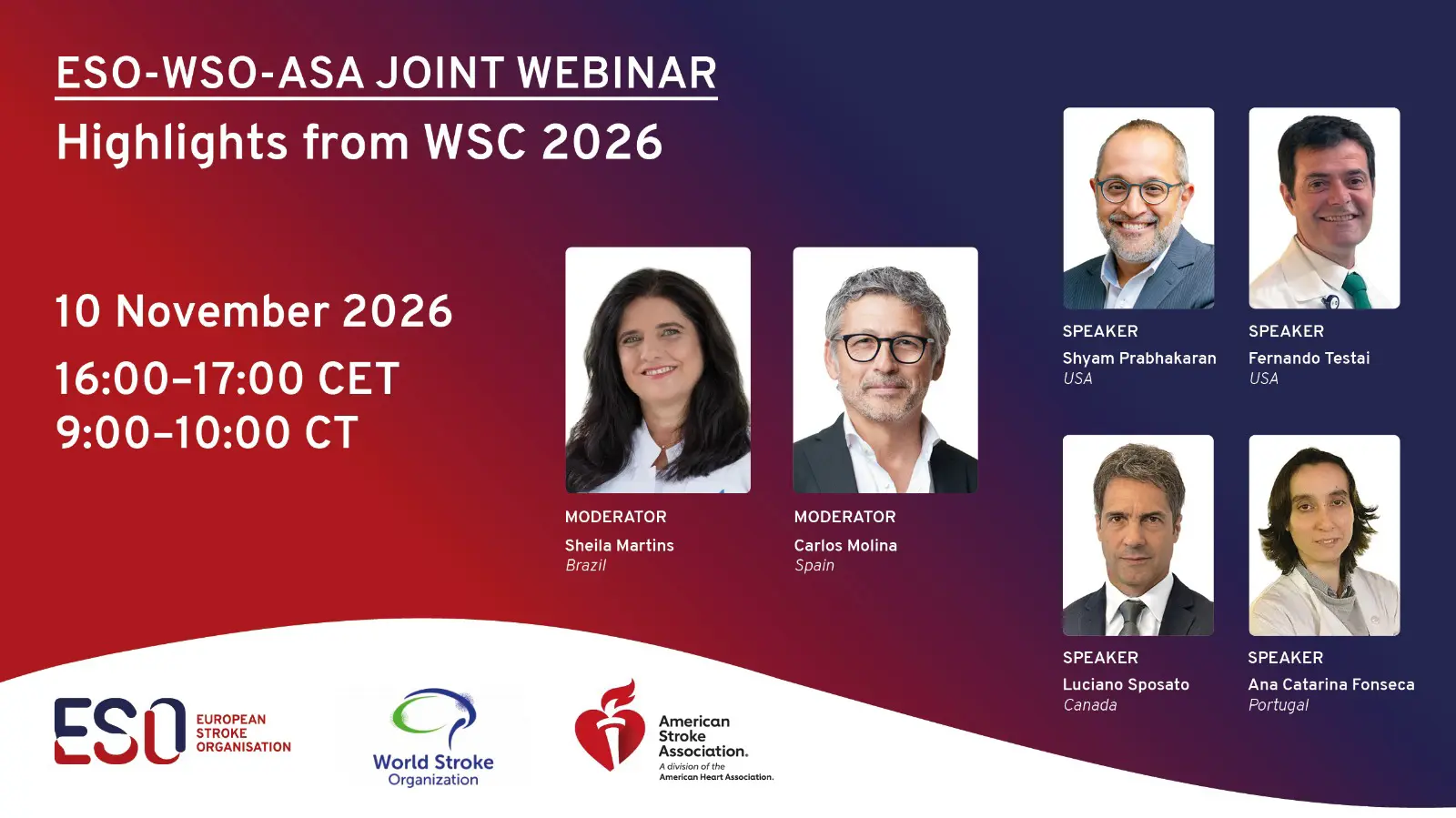
WSC 2026 Highlights - Joint webinar ESO-WSO-AHA/ASA
Join us for a live roundtable and Q&A session on Tuesday 10 November 2026 from 16:00-17:00 CET/9:00-10:00 CT to discuss the most important advances in research and clinical care of patients with stroke.
Highlights from the World Stroke Congress (WSC 2026) will be presented by experts from leading stroke societies: the European Stroke Organisation (ESO), the World Stroke Organization (WSO) and the American Heart Association/American Stroke Association (AHA/ASA). This collaborative session will highlight important research, evolving treatment strategies, and novel techniques in stroke care.